Service
Bathroom Renovation
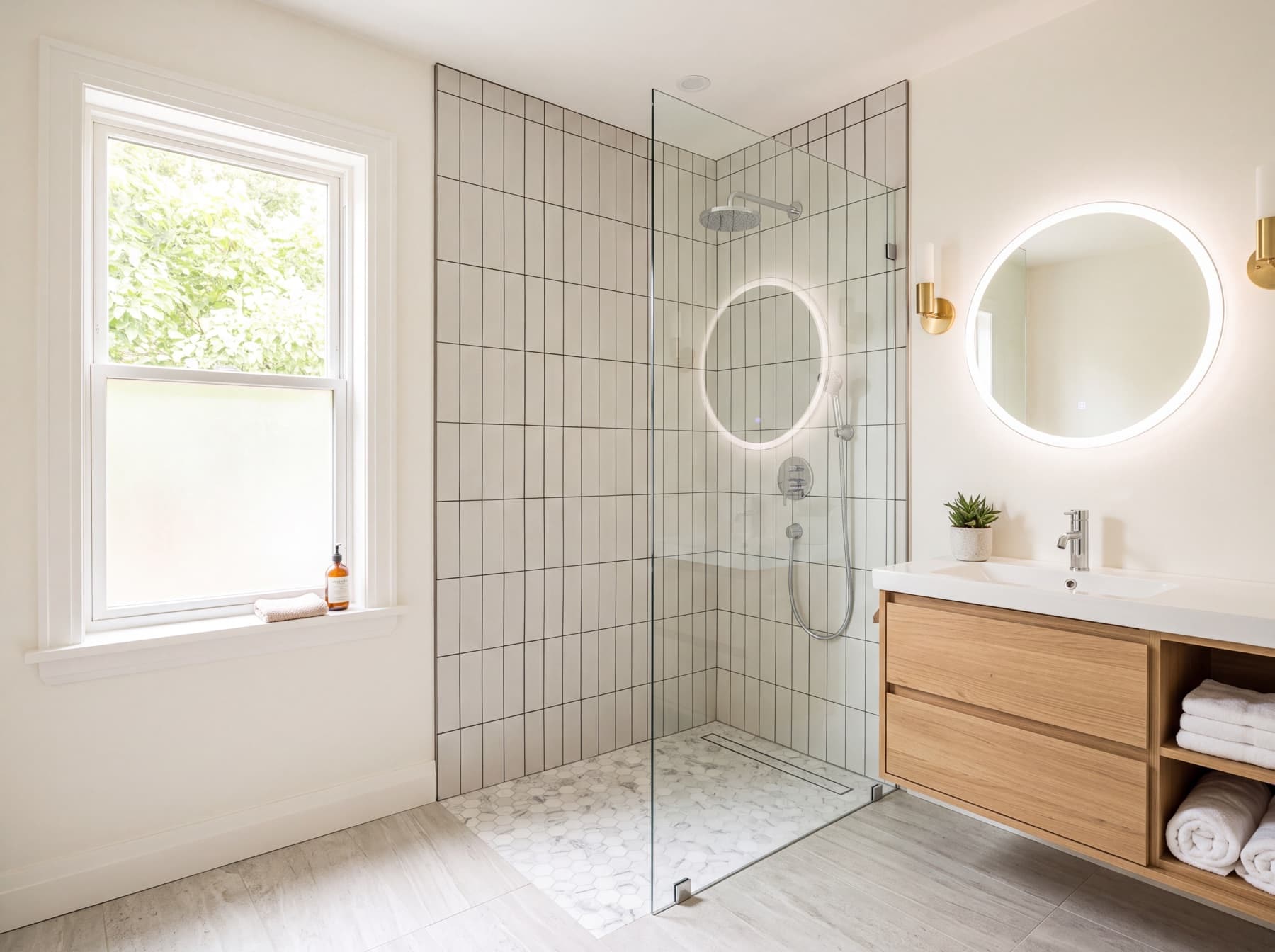
Targeted bathroom renovation for updates that don't require a full gut — new flooring, a walk-in shower conversion, updated plumbing fixtures, or a refreshed vanity and lighting.
Not every bathroom needs a full gut. If the layout works and the plumbing is sound, a targeted renovation — new tile, a tub-to-shower conversion, updated fixtures — gets most of the visual and functional upgrade of a full remodel without the six-week timeline or the five-figure price tag.
How Long Does a Bathroom Renovation Take?
A focused renovation like a tub-to-shower conversion typically runs 1 to 2 weeks end-to-end, with the actual installation work — once materials arrive and demo starts — taking 2 to 5 working days. That's a fraction of the 6-to-10-week timeline a full layout remodel requires, because the plumbing rough-in and floor plan usually stay untouched.
Most of that 1-to-2-week window isn't construction time — it's lead time. Shower systems, glass enclosures, and tile are typically custom-cut or special-ordered for the specific bathroom, which takes 1 to 2 weeks on its own before installation can even begin. Once the crew is on-site, a standard conversion follows a predictable sequence:
- Demo — removing the existing tub, surrounding tile, and any damaged wall material behind it.
- Inspection — checking the subfloor and wall framing for water damage before anything new goes in, since old tubs are a common source of hidden leaks.
- Plumbing adjustments — repositioning the drain and supply lines for the new shower base, if needed.
- Waterproofing and installation — the new shower base or pan, wall system or tile, glass enclosure, and fixtures.
- Final details — grout, caulk, hardware, and a walkthrough.
Key takeaway
Budget 1 to 2 weeks total for a straightforward tub-to-shower conversion, most of it spent waiting on custom-cut materials rather than construction itself. Projects that add glass, seating, accessibility features, or turn up unexpected plumbing issues run longer — ask your contractor to flag those risks before demo starts, not after.
Custom features push the timeline out. A frameless glass enclosure, a built-in bench, accessibility grab bars and a curbless entry, or a plumbing relocation all add real time — either because the components themselves are made to order or because the underlying work is more involved. The other common cause of delay isn't the renovation plan at all: it's what gets found once the old tub and tile come out. Older homes with original plumbing or hidden water damage behind the tub surround often need repair work that wasn't part of the original quote.
How Much Does It Cost to Retile a Bathroom?
A full bathroom retile — floor and walls — typically runs $3,000 to $12,000, with a small bathroom full retile landing around $3,500 to $5,500 including demolition, disposal, and new waterproofing membrane underneath.
Floor and shower retiling are usually quoted separately, and the numbers aren't close:
- Floor only — for a standard 5-by-8-foot (40 sq ft) bathroom floor, expect $120 to $2,100 for materials and installation, depending on tile type.
- Shower only — retiling a shower runs $8 to $40 per square foot, or roughly $800 to $3,000 for a standard shower. Large walk-in showers with high-end tile, accent patterns, or a built-in niche can run up to $10,000.
Showers cost noticeably more per square foot than floors for a straightforward reason: vertical tile work is slower to install correctly, and waterproofing behind shower walls has to be done right the first time — a failure there causes water damage inside the wall cavity that isn't visible until it's already extensive.
What actually moves retiling cost up or down:
- Tile size and material. Large-format tile installs faster per square foot than small mosaic or subway tile, but material costs more per square foot for high-end porcelain or natural stone.
- Pattern complexity. A herringbone or chevron layout takes significantly longer to install than a straight grid pattern, and that labor time shows up directly in the quote.
- Extras. A built-in shampoo niche, a bench, or accent tile bands each add labor and material cost beyond the base square footage.
- What's underneath. If the substrate needs repair or the waterproofing membrane has to be redone — common in older homes — that's added cost, not something a reasonable contractor should skip to hit a lower number.
Retiling alone, without a fixture swap or layout change, is one of the more cost-effective ways to meaningfully update a bathroom's look — especially when the existing vanity, toilet, and plumbing are all in good working order and don't need to be touched.
Renovation vs. Full Remodel: How to Tell Which One You Need
The line between "renovation" and "remodel" comes down to whether the layout changes. If the toilet, sink, and shower or tub stay where they are and the work is cosmetic and fixture-level — new tile, a tub-to-shower swap, an updated vanity, fresh paint and lighting — that's a renovation, and it can usually be done in one to two weeks without moving plumbing. If the project involves relocating fixtures, expanding the footprint, or reconfiguring the room, that's a remodel, and it needs the longer timeline and larger budget that comes with new plumbing runs and a full permit process.
A good way to think about it: a renovation improves what's already there, while a remodel changes what's there. Most bathrooms that look dated but function fine — old tile, an outdated vanity, a tub nobody uses — are strong renovation candidates. Bathrooms with a genuinely awkward layout, insufficient storage, or plumbing that's failing regardless of cosmetics usually need the full remodel to actually solve the underlying problem instead of just refreshing the surface.
Where We Offer Bathroom Renovation
What Homeowners Look For
A few things customers consistently tell us matter most.
Frequently Asked Questions
Ready to get this fixed?
Call now or request a free estimate — we'll get back to you fast.